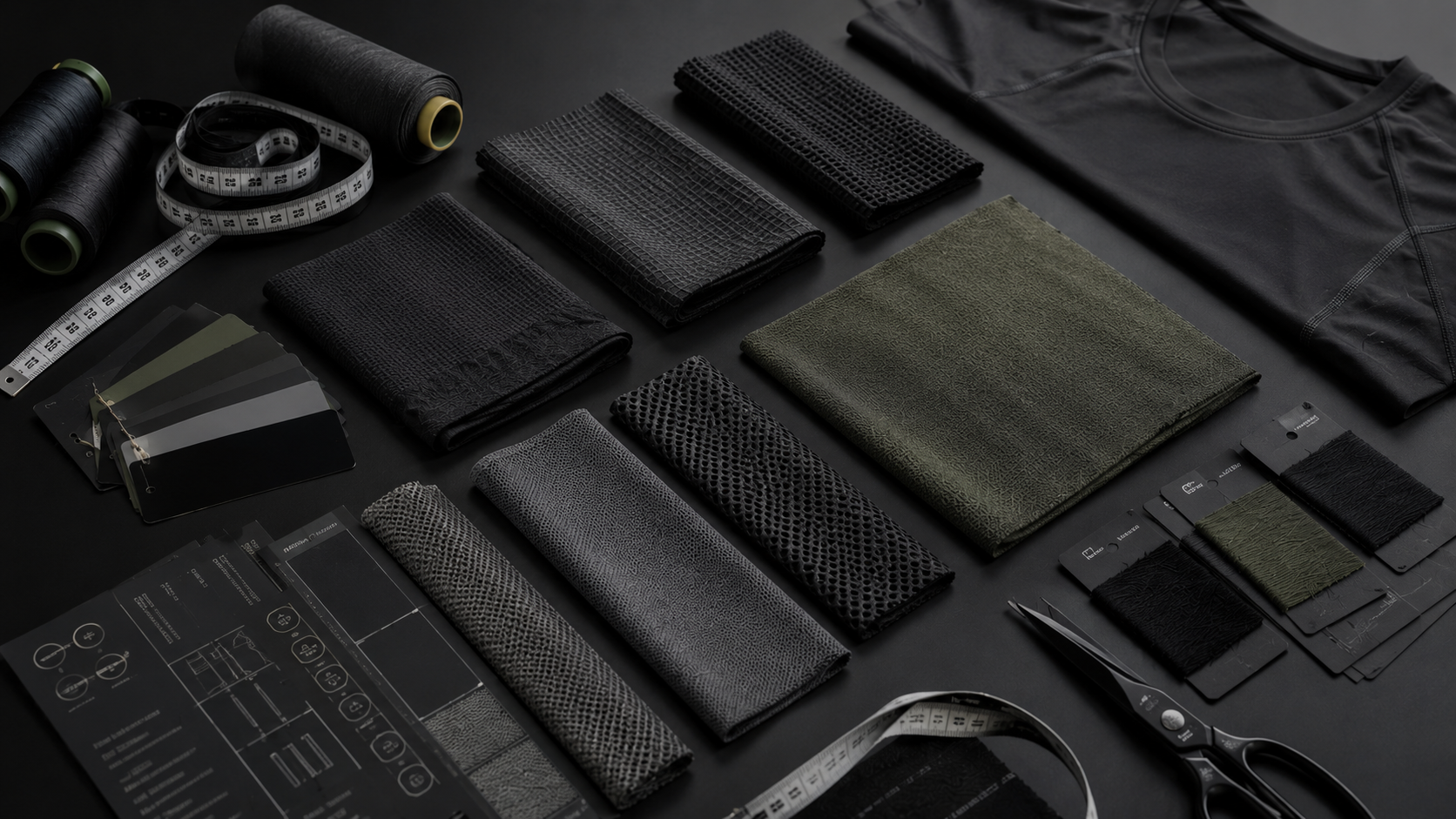
Ask a new brand what fabric they want for their gym wear and the answer is often just "something stretchy that wicks sweat." That's a reasonable starting instinct, but it leaves out the decisions that actually determine how a garment performs and feels: fibre blend ratio, GSM, stretch direction, and finish. Two leggings can both be described as "polyester-spandex" and feel completely different on the body — one compressive and supportive, the other thin and see-through under stretch.
This guide breaks down the fabric decisions that matter for gym wear specifically, so you can have a more precise conversation with your manufacturer than "make it feel premium." It covers the fibre blends most commonly used across leggings, sports bras, shorts and outerwear, how to read and use GSM as a real decision-making tool rather than a spec sheet afterthought, and how to think about durability and sustainability in a way that actually affects the product your customer receives.
None of this requires a background in textiles. Most of it comes down to knowing which questions to ask, and insisting on a physical swatch or sample before locking in a bulk fabric order — the single habit that separates activewear brands with a reputation for quality from ones that quietly struggle with returns and complaints about sheerness, pilling or fading.
In activewear, fabric is doing structural work that ordinary clothing fabric doesn't have to do. It needs to stretch and recover its shape through thousands of repeated movements, manage moisture without holding onto odour, resist pilling from friction against gym equipment, and often provide graduated compression for support. A beautifully designed legging in the wrong fabric will still disappoint the customer wearing it — going sheer during a squat, losing shape after a few washes, or trapping heat during a hard session. Fabric selection isn't a finishing detail; it's the foundation the rest of the product is built on.
This is also where a lot of the real cost difference between "budget" and "premium" activewear actually lives, more than in branding or packaging. Two brands can use nearly identical patterns and silhouettes and still deliver a completely different customer experience purely because one sourced fabric from a mill with tighter quality control and better raw fibre, while the other prioritized the lowest per-metre cost. Customers can usually feel this difference within the first few wears, even if they can't articulate exactly why one pair of leggings feels noticeably better than another.
The majority of gym wear on the market — leggings, sports bras, shorts, tanks — is built from a polyester-spandex (elastane) blend, typically somewhere between 82/18 and 88/12 polyester to spandex. Polyester provides durability, shape retention, and takes dye well for vibrant, long-lasting colour. Spandex provides the stretch and recovery. Higher spandex content generally means more stretch and a closer, more supportive fit, but can reduce breathability and durability slightly if pushed too high.
Within this category there's a wide quality range. Circular-knit polyester-spandex from a reputable mill will hold its shape and colour through hundreds of washes; a cheaper, loosely knit version from an unspecified source can pill within weeks and lose compression fast. This is one of the areas where asking your manufacturer for a physical swatch before committing to a bulk fabric order pays for itself many times over.
Nylon-elastane blends are the standard choice for higher-compression products — recovery leggings, compression tights, and premium sports bras. Nylon has a smoother hand-feel than polyester, a slightly higher stretch recovery rate, and a distinctive matte-to-slight-sheen finish that many premium activewear brands use as a visual signal of quality. It's typically more expensive than polyester-spandex, which is why it tends to appear in higher price-point products or specific compression-focused categories rather than across an entire basics range.
A fabric composition listed on a spec sheet doesn't tell you how a fabric feels or behaves under real stretch. Always request a physical swatch, and ideally a small fabric sample stretched and washed a few times, before locking a bulk fabric order.
Moisture-wicking isn't a fibre type — it's a fabric construction and finish that pulls sweat away from the skin to the outer surface of the fabric, where it can evaporate faster. This is typically achieved through the fabric's knit structure (channels that move moisture outward) combined with a hydrophilic finish applied during fabric processing. Cheaper "wicking" fabrics sometimes rely on the finish alone, which can wash out over time, reducing performance after repeated laundering. Ask your manufacturer whether the wicking property is structural (built into the knit) or purely a topical finish, since this affects how long the performance benefit actually lasts in the customer's hands.
GSM (grams per square metre) measures fabric weight and density. It's one of the most useful numbers for comparing fabric options, because it directly affects opacity, warmth, durability and cost. As a general guide for activewear:
Opacity is one of the most common quality complaints in activewear, particularly with leggings under stretch during a squat or lunge. If squat-proof opacity matters to your product positioning, specify a minimum GSM and request a stretch-test sample specifically checking opacity under deep stretch, not just at rest. It's worth noting that GSM alone doesn't guarantee opacity — knit density and yarn quality also play a role, which is another reason a physical stretch test beats relying on a number on a spec sheet.
A fabric spec sheet tells you what a fabric is made of. A stretch test tells you whether it actually works.Elevatex Editorial Team
Two-way stretch fabric stretches in one direction (usually width), while four-way stretch fabric stretches and recovers in both length and width. Nearly all modern gym wear uses four-way stretch, because it allows the garment to move naturally with the body through a full range of motion — a squat, a deep lunge, an overhead reach — without pulling or restricting movement in one direction. Two-way stretch is occasionally used in more structured pieces like waistbands or panels where controlled, directional compression is intentional rather than a limitation.
Recycled polyester (often made from post-consumer plastic bottles, labelled rPET) and recycled nylon (regenerated from fishing nets and other nylon waste, often branded as ECONYL or similar) have become increasingly available in performance-grade activewear fabric, with stretch, durability and wicking performance now largely comparable to virgin fibre equivalents from quality mills. These fabrics typically carry a modest cost premium over standard polyester-spandex, but for brands positioning around sustainability, they're a genuine differentiator worth discussing with your manufacturer early, since not every factory stocks or sources these fabrics as standard.
Pilling — the small fabric balls that form from friction, usually where a garment rubs against gym equipment, a yoga mat, or another piece of clothing — is one of the fastest ways a gym wear product loses its premium feel, often within the first few wears. Pilling resistance comes down to fibre quality and knit tightness more than fibre type alone; a well-constructed polyester-spandex blend from a quality mill can resist pilling significantly better than a loosely knit nylon-elastane from an inconsistent source. If pilling resistance matters for your product — and for anything positioned as premium, it should — ask your manufacturer specifically about the fabric mill's pilling test results (often measured using a standard Martindale abrasion test) rather than assuming fibre type alone guarantees performance.
Colour retention matters just as much, particularly for darker, saturated colourways that are popular in activewear but prone to fading with repeated washing and UV exposure. Polyester generally holds dye more consistently over time than nylon, which is one reason many brands default to polyester-spandex blends for their core colour range and reserve nylon-elastane for specific premium or compression-focused styles where the trade-off is worth it. Requesting a washed sample — not just a fresh-off-the-roll swatch — is the only reliable way to judge how a fabric will actually look and feel after it's been through a customer's washing machine a dozen times.
Different product categories genuinely need different fabric approaches, and a single all-purpose fabric rarely serves an entire product range well:
Sharing your product type, use case, and climate context with your manufacturer upfront — rather than just saying "premium performance fabric" — gets you a much more useful first recommendation, and a fabric swatch that's actually worth testing.
The brands that consistently get fabric right treat it as a specification to lock down early, alongside pattern and construction, rather than a detail to finalize once everything else is decided. Build a small swatch library as you develop your range — even a shoebox of labelled fabric samples from different mills and GSMs — and you'll find future product development conversations with your manufacturer move faster, because you already have a point of reference for what "compression enough" or "opaque enough" actually feels like in your hand.
Elevatex International helps brands of every size — from first-time founders to established teamwear programs — go from a design brief to a finished, quality-checked product. Tell us what you're building.
Talk to Our TeamMost brands land between 260 and 300 GSM for reliably opaque, squat-proof leggings, though the safest approach is requesting a stretch-test sample at your target GSM and checking opacity under a deep squat or lunge before finalizing.
Neither is universally better — nylon offers a smoother hand-feel and slightly better stretch recovery, often used in premium or high-compression products, while polyester offers strong durability and colour retention at a more accessible cost, making it the standard choice across most gym wear categories.
It can, if the wicking performance relies primarily on a topical finish rather than the fabric's underlying knit structure. Ask your manufacturer whether wicking is structural or finish-based to understand how durable the performance will be after repeated washing.
Four-way stretch fabric stretches and recovers in both length and width, allowing full range of motion, and is standard for most gym wear. Two-way stretch moves in one direction only and is occasionally used for structured panels like waistbands.
From established mills, recycled polyester and nylon now perform comparably to virgin fibre equivalents in stretch, durability and wicking, though quality still varies by supplier — the same swatch-testing approach applies regardless of whether the fabric is recycled or virgin.

Screen printing, sublimation, and embroidery each solve a different problem. Choosing the wrong one is how brands end up with logos that crack, fade, or never fit the fabric.
Read Article
Private label is the fastest way to get a branded product line to market without building a factory. Here's exactly what a manufacturer handles, and what you still own.
Read Article
Club and league orders come with their own rules — full size runs, individual names and numbers, tight seasonal deadlines. Here's how a teamwear production run actually works.
Read Article