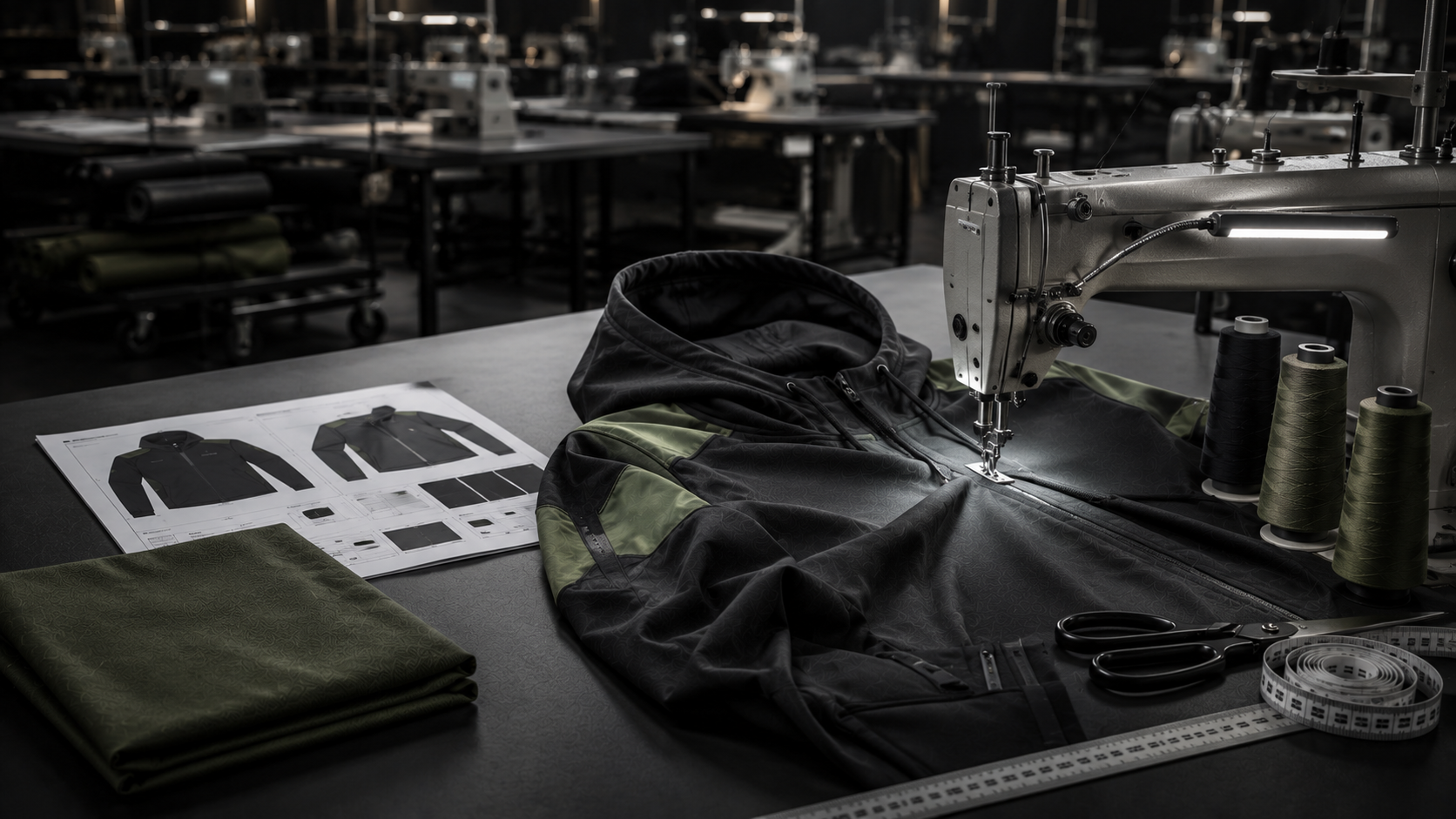
A custom hoodie starts as a flat sketch and a handful of decisions on paper — fabric weight, fit, colourway, logo placement. What happens between that sketch and a finished, folded garment ready to ship is a sequence of distinct manufacturing stages, each with its own skill set, equipment, and potential for something to go wrong if a detail wasn't communicated clearly upfront.
This is a walkthrough of how custom apparel actually gets made — the stages in order, what happens at each one, and why the process takes the time it does. It's worth understanding this sequence even if you never plan to visit a factory floor yourself, because knowing what's actually involved makes it much easier to have a specific, informed conversation with a manufacturer, spot an unrealistic timeline before you commit to it, and understand exactly where a delay or quality issue originated if one comes up.
Before any fabric is cut, a manufacturer needs a locked, approved design — ideally captured in a tech pack with measurements, construction notes, fabric specification and artwork files. Skipping this step, or leaving it vague, is the single most common cause of delays and revisions later in the process, since every downstream stage — pattern making, cutting, sewing — depends on having clear, unambiguous specifications to work from.
It's worth treating this locking step as genuinely final before moving forward. Changes requested after pattern making has begun, or worse, after fabric has already been cut, are far more disruptive and expensive than the same change made while the design still exists only on paper. A few extra days spent reviewing a tech pack thoroughly before signing off on it routinely saves weeks of rework later in the process.
A pattern maker translates the design into a set of flat templates — one per garment panel — that, once cut and sewn together, form the three-dimensional shape of the finished product. If you're working under an OEM arrangement with a fully custom design, this pattern is built from scratch based on your tech pack. Under ODM, an existing base pattern is adjusted to your brief instead.
Once a base pattern exists in one size, it needs to be graded — mathematically scaled up and down to produce the full size run (XS through XXL, for example) while keeping proportions consistent across sizes. Grading is a specialized skill; a poorly graded pattern can result in a garment that fits correctly in the sample size but noticeably wrong in the sizes above and below it.
Modern pattern making increasingly uses computer-aided design software to draft and grade patterns digitally, which improves consistency compared to fully manual grading, though the underlying skill of interpreting a design brief into an accurate pattern remains a specialist craft regardless of the tools used. A pattern that looks correct on screen still needs to be physically test-cut and sewn into a real sample to confirm it behaves as expected once actual fabric, with its own drape and stretch characteristics, is involved.
A single approved sample in one size doesn't guarantee correct fit across the whole size run. Ask your manufacturer whether they test-fit multiple sizes from the graded pattern before bulk cutting begins.
Once the pattern is finalized, fabric is sourced to the confirmed specification — fibre composition, GSM, colour — either from stock rolls for a standard fabric, or through a custom dyeing or printing run if the design calls for a specific colour match or an all-over sublimated print. Fabric is then laid out in multiple layers and cut according to the graded pattern pieces, typically using either manual cutting tools for smaller runs or computerized cutting machines for larger, more precise bulk orders.
Cutting accuracy matters more than it might seem — a pattern piece cut even slightly off-grain (not aligned correctly with the fabric's natural stretch direction) can cause a finished garment to twist or fit unevenly once sewn, particularly noticeable in stretch fabrics used for activewear. Fabric is typically inspected for flaws — colour inconsistency, weave defects, print misalignment — before cutting begins, since a flaw caught at this stage costs only the affected fabric length, while the same flaw discovered after sewing means scrapping a partially or fully constructed garment.
Cut panels move to sewing, where skilled machine operators assemble the garment panel by panel — side seams, shoulder seams, waistbands, cuffs — following the construction notes in the original tech pack. Different seam types (flatlock, overlock, coverstitch) serve different functions: some prioritize a flat, chafe-free finish against skin for activewear, others prioritize strength for load-bearing seams like waistbands. A manufacturer experienced in sportswear specifically, rather than general apparel, tends to have deeper expertise in these performance-specific construction details.
The construction details that never appear in a product photo — seam type, stitch density, elastic tension — are usually the ones that determine whether a garment survives its first year of wear.Elevatex Editorial Team
Depending on the chosen method, decoration happens either before construction (sublimation, where fabric is printed flat before cutting) or after (screen printing and embroidery, typically applied to a fully or partially constructed garment). Our guide to screen printing vs sublimation vs embroidery covers how to choose the right method for your design and fabric.
This stage also includes attaching labels, hang tags, and any additional trims — drawstrings, zippers, elastic bindings — that complete the garment's construction and branding.
Finishing includes trimming loose threads, pressing or steaming the garment into its final shape, and a quality inspection checking stitching consistency, correct label placement, colour accuracy against the approved sample, and overall measurement accuracy against the spec sheet. Reputable manufacturers run this inspection at multiple points — not just at the very end — catching issues earlier when they're cheaper and faster to fix, rather than after an entire batch has already moved through every subsequent stage.
A thorough final inspection typically involves checking a statistically representative sample of the finished batch — not every single unit, which would be impractical at scale, but enough units, selected across different points in the production run, to catch a systemic issue if one exists. Ask your manufacturer what inspection standard and sample size they use for pre-shipment quality control, since this varies and directly affects how confident you can be in the consistency of the full batch you receive.
Behind each of these stages sits a different specialist, not a single generalist worker moving a garment through the whole process alone. Pattern makers and graders typically work separately from cutting room staff, who in turn hand off to sewing line operators trained on specific machine types — flatlock, overlock, coverstitch — each suited to a different seam. Decoration is usually its own department entirely, whether that's a dedicated screen printing team, a sublimation press operator, or embroidery machine technicians, and quality control inspectors work independently of the production line itself, so the people checking the work aren't the same people who produced it.
This division of labour is part of why manufacturing at scale produces more consistent results than a single small workshop trying to handle every stage with the same small team — each specialist is focused on one part of the process, developing deep expertise in that specific stage rather than spreading attention across the entire garment build. It's also why visiting or closely understanding a factory's actual production floor, rather than judging capability purely from a sales conversation, can be genuinely useful for a buyer trying to assess whether a manufacturer is set up to handle their specific product well.
Finished garments are folded, tagged, and packed according to your specification — individual polybags, bulk cartons by size, or branded retail packaging if that was part of your order. Packing lists and carton labelling are prepared to match your shipping and customs requirements, particularly important for international shipments where accurate documentation affects customs clearance speed at the destination.
For a typical custom apparel order: pattern development and first sample generally takes one to two weeks, sample approval and any revisions add another one to two weeks, and bulk production — cutting, sewing, decoration, finishing and packing — typically takes three to five weeks depending on order size and decoration complexity. Shipping time is separate again, ranging from a few days by air freight to several weeks by sea, depending on destination and method chosen.
Understanding this sequence — and where the realistic time commitments sit within it — helps set expectations for a first order, and makes it much easier to spot an unrealistic quote that promises a full production run in an implausibly short window. If a manufacturer's quoted timeline seems dramatically faster than these general ranges, it's worth asking specifically which stages they're compressing, and how — sometimes there's a legitimate reason, such as an already-stocked fabric that skips a sourcing wait, but sometimes it signals a step, like sampling or inspection, being skipped or rushed entirely.
Elevatex International helps brands of every size — from first-time founders to established teamwear programs — go from a design brief to a finished, quality-checked product. Tell us what you're building.
Talk to Our TeamFor a typical order, expect roughly two to four weeks for pattern development, sampling and approval, followed by three to five weeks for bulk production, plus separate shipping time depending on the method chosen.
Stretch fabrics require careful attention to grain alignment during cutting, since misalignment can cause the finished garment to twist or fit unevenly once the fabric's natural stretch direction is engaged during wear.
A sample only confirms fit in one size. Grading extends that pattern across your full size range, and if done poorly, sizes other than the sample size can fit noticeably differently, even though the sample itself looked correct.
Reputable manufacturers check quality at multiple points throughout production, not just at the end, since catching an issue early — during cutting or sewing — is faster and cheaper to correct than after an entire batch has moved through every subsequent stage.
It depends on the method. Sublimation is applied to flat fabric before cutting and sewing, while screen printing and embroidery are typically applied to a fully or partially constructed garment, after the main panels are assembled.

A tech pack is the document that turns an idea into a garment a factory can actually cut and sew. Here's what belongs in one, and what happens when it's missing.
Read Article
One continuous walkthrough of the entire sportswear manufacturing process — from a locked tech pack to a container leaving the port — and where delays usually creep in.
Read Article
Everything a first-time founder needs to think through before placing a single production order — niche, product range, budget, and the manufacturing decisions that make or break year one.
Read Article