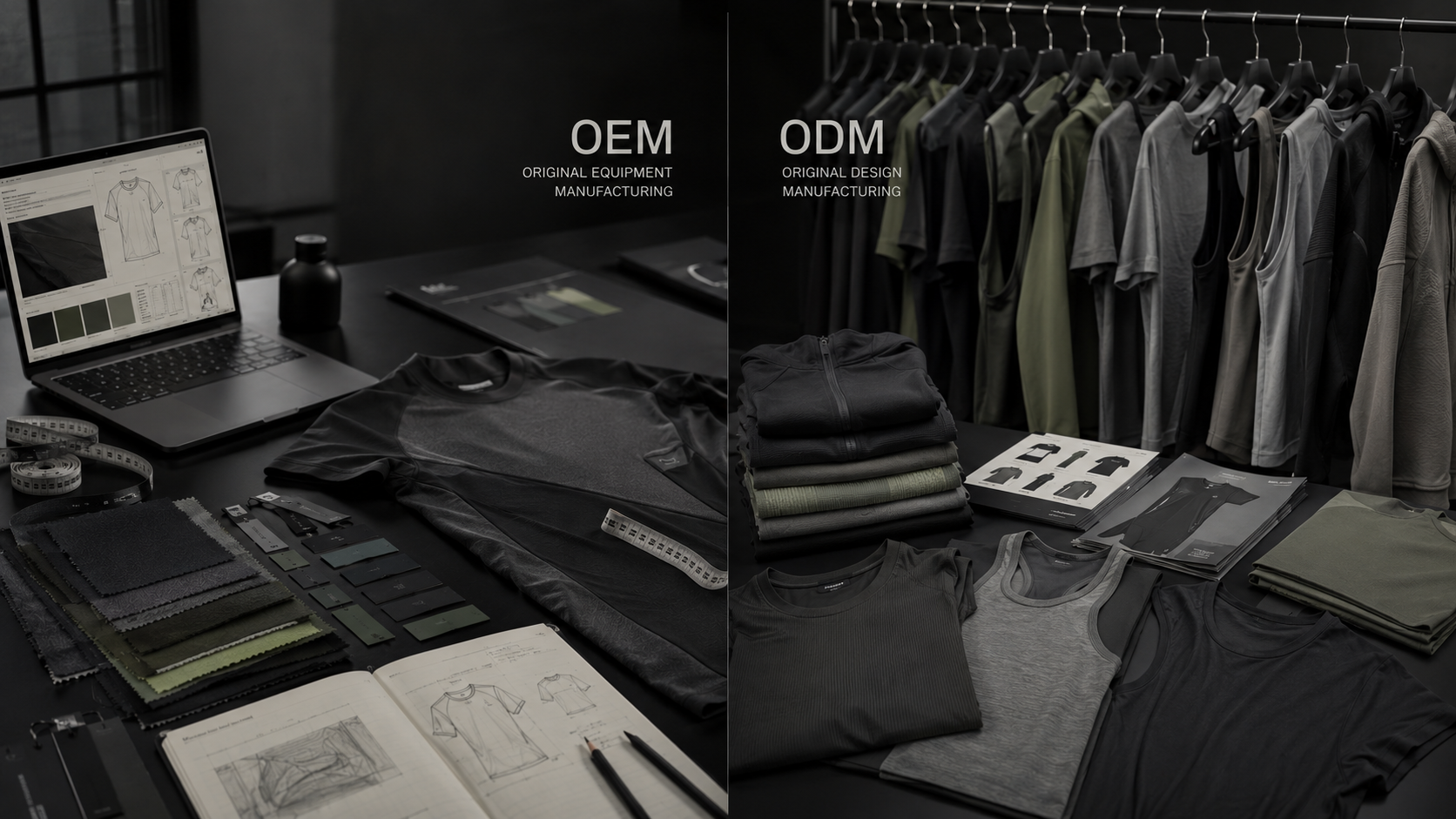
If you've spent any time researching apparel manufacturing, you've run into the acronyms OEM and ODM within the first few pages. Both describe a factory making a product that carries your brand — but the similarity ends there. The two models put a completely different amount of design responsibility, upfront cost, and creative control in your hands, and choosing the wrong one for where your brand actually is right now is one of the more expensive mistakes a new label can make.
This is a practical breakdown of what each term means in a real sportswear production context, not just the textbook definition, and how to figure out which one actually fits your business today. It matters more than it might seem: the model you choose affects how fast you can get to a first sample, how much you'll spend before a single garment is sewn, how much say you'll have over the finished fit and construction, and whether the design remains something only your brand can produce or something a factory could, in principle, offer to another client with minor tweaks.
Neither model is inherently better. Some of the most successful sportswear brands on the market today started on an ODM base pattern with smart branding and marketing layered on top; others built their entire identity around a proprietary construction detail that only exists because they invested in full OEM development from day one. The right answer depends entirely on where your brand is, and what you're actually trying to build.
OEM stands for Original Equipment Manufacturer, though in apparel it's more accurately described as "you design it, we build it." Under an OEM arrangement, you bring the factory a complete or near-complete package: a tech pack with measurements, construction details, fabric specification, and artwork for any prints, embroidery or labels. The manufacturer's job is to execute that design faithfully — cutting, sewing, and finishing the garment exactly to your spec.
This is the route most established brands use, because it gives them complete control over fit, construction, and design, and it lets them work with multiple factories on the same product line without redeveloping the design from scratch each time. The tradeoff is that OEM requires you to already have — or to commission separately — a real technical package. A vague sketch or a screenshot of a competitor's product isn't enough for a factory to build to.
ODM stands for Original Design Manufacturer. Here, the factory's own design and product development team does the heavy lifting: adjusting an existing base pattern, recommending fabric and construction based on what already works for that product category, and often bringing you close to a first sample based on a brief rather than a full technical spec.
ODM is significantly faster to get to a first sample if you don't have pattern-making or technical design experience in-house, because you're leaning on the factory's existing library of patterns and production know-how. The tradeoff is less granular control — you're working within variations of what the factory already knows how to produce well, rather than a completely from-scratch design.
Whether you go OEM or ODM, "private label" refers to whether the finished product carries your own labels, hang tags and packaging — that's independent of who designed the pattern. See our private label sportswear guide for more detail.
In practical terms, ODM products often reach a first sample faster — sometimes a week or more quicker than a from-scratch OEM development — because the factory is adjusting rather than building a pattern. Bulk production timelines, once a sample is approved, tend to be similar for both routes: fabric sourcing, cutting, sewing and finishing take roughly the same time regardless of who designed the original pattern.
Where OEM tends to cost more is in the development phase, particularly if you're commissioning tech pack creation, pattern grading, or multiple fit sample rounds from scratch. ODM shifts more of that cost into the factory's existing overhead, which is part of why it's often the more accessible entry point for a first-time brand.
The question isn't which model is better — it's which one matches how much design work you're actually equipped to do yourself.Elevatex Editorial Team
OEM makes the most sense once you have, or can commission, a real tech pack — either because you have in-house design capability, work with a freelance pattern maker, or are moving an existing successful design to a new manufacturer. It's also the right call if design differentiation is central to your brand positioning: if your competitive edge is a genuinely different fit, construction detail, or fabric combination that doesn't exist anywhere else yet, you need the control OEM provides.
Established brands scaling into a second or third manufacturer, or bringing production in-house from a previous white-label supplier, are typically OEM by default, because they already have the technical documentation to hand over.
ODM is usually the better starting point for a first-time founder without design or pattern-making experience, or for a brand that wants to launch quickly and validate demand before investing heavily in custom pattern development. It also works well for brands whose differentiation is more about branding, marketing, and niche positioning than about a completely unique garment construction — a common and entirely valid strategy, especially in categories like basic gym wear, hoodies, or team training kits where the underlying garment shape is already well established.
If your priority is getting a well-made, properly fitted product to market within a few months rather than developing a proprietary silhouette, ODM removes a significant amount of the technical burden.
In practice, a lot of successful brands don't pick one model and stay there. A common pattern: launch with ODM to get a first collection to market quickly and affordably, use the sales and customer feedback from that launch to identify what needs to change, and then move to OEM for a second-generation product once there's a clear, validated reason to invest in custom pattern development — a fit issue customers keep mentioning, a fabric upgrade, a construction detail competitors don't offer.
This staged approach avoids over-investing in custom design before you know whether the product category and price point actually work for your audience, while still leaving the door open to full design control once the brand has traction.
One area brands often overlook when comparing OEM and ODM is what happens to quality control once you scale beyond a first order. Under OEM, because you hold the full spec sheet, quality checks can be measured directly against your own documented tolerances — a waistband elastic that should sit at a specific width, a seam allowance that should measure within a defined range. Any factory you work with, including a second or third manufacturer down the line, can be held to the exact same written standard.
Under ODM, quality is typically measured against the factory's own internal standard for that product family, which is usually solid — factories don't build a reputation on inconsistent products — but it's less directly yours to define and audit line by line. This matters more as you scale: a brand doing 500 units a season may not notice the difference, but a brand doing 20,000 units across multiple factories usually wants the precision that a fully-owned tech pack provides.
Design ownership follows a similar pattern. If protecting a specific construction detail or fit from being replicated by other brands working with the same factory matters to your business, OEM with a written agreement covering pattern exclusivity is the stronger route. ODM patterns, by nature of being built from a factory's existing base, are more likely to share DNA with other products in that factory's catalogue, even after customization.
A few honest questions tend to clarify the decision quickly:
Whichever route you choose, the manufacturer relationship matters more than the acronym. A good manufacturing partner will walk you through which approach fits your specific product and timeline rather than pushing you toward whichever is more convenient for them — and will be equally comfortable working from your locked spec sheet or developing one alongside you from a brief.
It's also worth asking any manufacturer you're evaluating how they handle the transition if you do want to move from ODM to OEM later — whether they'll help formalize a tech pack based on an ODM product you've already validated, and whether they're willing to grade and document that pattern so you own it going forward. A manufacturer that treats this as a normal, expected part of a growing brand's journey, rather than a friction point, is usually a good sign for the relationship overall.
Elevatex International helps brands of every size — from first-time founders to established teamwear programs — go from a design brief to a finished, quality-checked product. Tell us what you're building.
Talk to Our TeamYes, this is common. Many brands start with an ODM product to validate the market, then commission a full tech pack for a second-generation version once they know exactly what changes they want, and move to an OEM arrangement for that version.
Typically the base pattern remains the factory's development, even though the finished design is customized to your brief. If pattern ownership matters to your business, clarify this in writing before production and consider an OEM arrangement instead.
ODM usually has lower development costs since you're not commissioning a tech pack from scratch, but bulk production pricing is largely determined by fabric, quantity and decoration method regardless of which route you choose.
OEM, since it gives you full control over pattern and construction. ODM works within variations of patterns the factory already knows how to produce, which suits customization but not a truly from-scratch silhouette.
You need access to a proper tech pack, whether that's built in-house, by a freelance pattern maker, or in some cases by the manufacturer as a paid development service before moving into full OEM production.

Picking a manufacturer is the single decision that determines whether your next two years are smooth or stressful. Here's what actually matters, beyond price per piece.
Read Article
Not all polyester-spandex blends are equal. Here's how GSM, compression, moisture-wicking finishes, and four-way stretch actually affect how your gym wear performs and feels.
Read Article
Screen printing, sublimation, and embroidery each solve a different problem. Choosing the wrong one is how brands end up with logos that crack, fade, or never fit the fabric.
Read Article