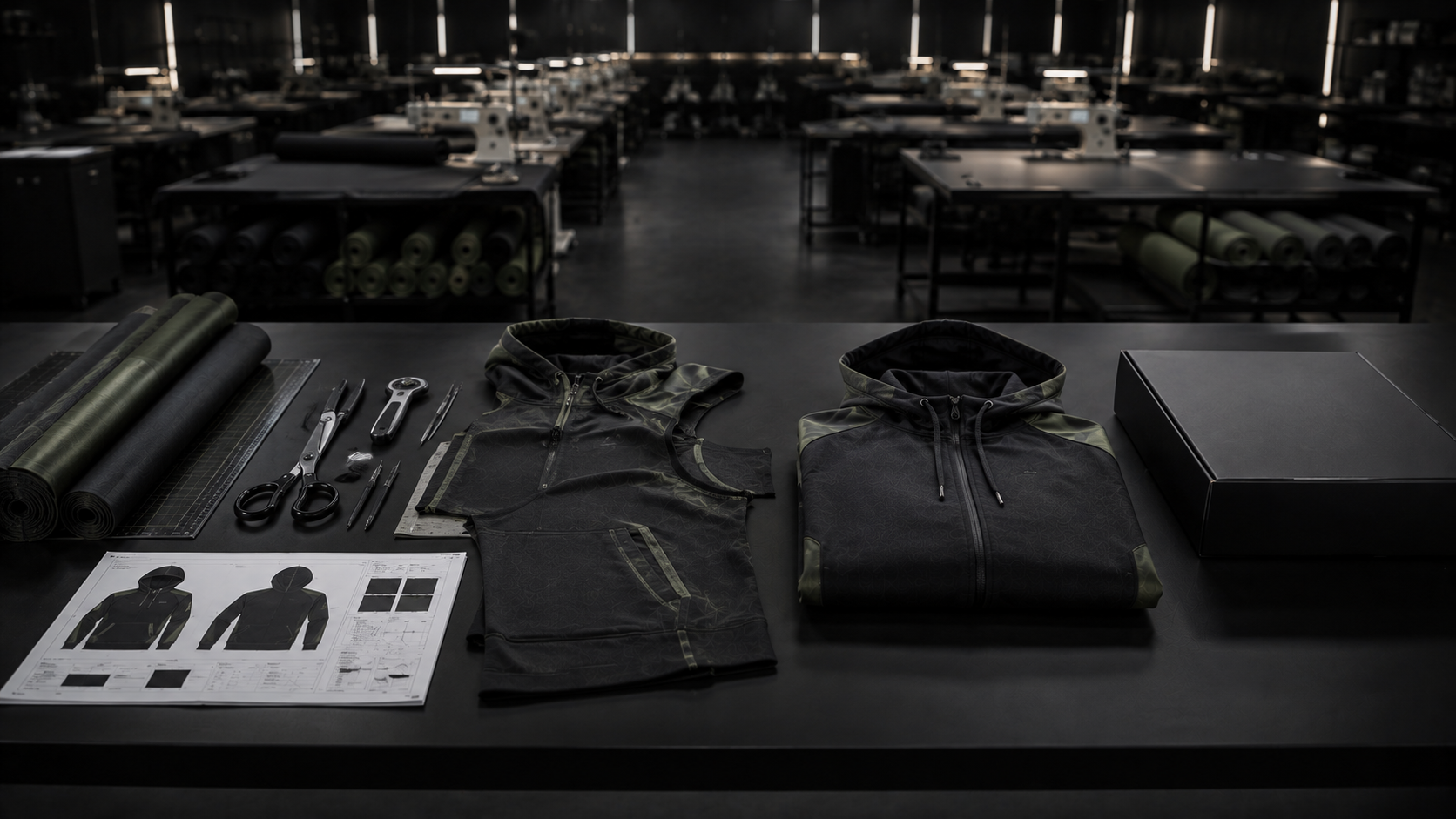
Sportswear manufacturing is often described in a single sentence — "we send the design, they make the product" — that skips over roughly a dozen distinct steps, each with its own timeline, potential failure points, and decisions that need to be made along the way. Understanding the full sequence, end to end, makes it much easier to plan realistic timelines, catch problems early, and know what questions to ask at each stage.
This is a complete walkthrough of the sportswear manufacturing process, from a locked design through to a container leaving the port, along with where delays most commonly happen and how to avoid them. It brings together, in one place, the individual stages covered in more depth elsewhere on this site — tech pack development, fabric sourcing, sampling, decoration methods, quality control — as a single continuous sequence, which is genuinely useful context whether this is your first production order or your fifteenth.
At a high level, the process moves through: design and tech pack development, fabric and trim sourcing, sampling and approval, bulk cutting and sewing, decoration, quality control, and finally packing and shipping. Each stage depends on the one before it being properly finished — starting bulk production before a sample is fully approved, for example, is one of the most common and costly sequencing mistakes in the entire process.
It's worth thinking of this sequence as a series of checkpoints rather than a single continuous flow, each one designed to catch a specific category of problem before it becomes expensive. A tech pack review catches ambiguity before a pattern is even cut. A sample approval catches fit and construction issues before bulk fabric is committed. A pre-shipment inspection catches quality inconsistencies before an entire order leaves the factory. Skipping or rushing any single checkpoint doesn't just risk a problem at that stage — it removes the safety net for every stage that follows it.
Everything starts with a locked design, ideally documented in a complete tech pack covering measurements, materials, and construction details. Whether you're working OEM or ODM, this stage typically takes one to two weeks and sets the foundation for everything that follows. Time invested here — reviewing the tech pack thoroughly, confirming every measurement and material spec before moving forward — consistently pays off in fewer revision rounds later.
Once the spec is confirmed, the manufacturer sources fabric to match — either from existing stock rolls for standard fabrics, or through a dyeing or printing run for custom colours and patterns. Trims (elastic, drawcords, zippers, labels) are sourced in parallel. Custom fabric, particularly sublimated prints, typically adds the most time to this stage, since it requires committing to a minimum yardage and waiting for the printing and curing process before cutting can begin. Standard, in-stock fabrics move through this stage considerably faster.
A sample is produced from the confirmed pattern, fabric and trims, and sent for your review. This is the stage where fit, fabric feel, colour accuracy and construction details get checked against your original intent — and where the majority of adjustments, if any are needed, get made before committing to bulk fabric. It's common to need one or two revision rounds here; treat this as a normal, expected part of the process rather than something to rush through to save time, since issues caught now are dramatically cheaper to fix than the same issues discovered after bulk cutting.
Verbal or informal approval ("looks good, go ahead") creates ambiguity about exactly what was approved. A clear written sign-off, referencing the specific sample version, protects both sides if a question comes up later.
Once the sample is formally approved, bulk fabric is cut according to the graded pattern across your full size run, then moves through sewing to construct the garments, and finally through decoration — screen printing, sublimation, or embroidery — and label attachment. For a typical order, this stage takes three to five weeks depending on order size, decoration complexity, and the manufacturer's current production schedule and capacity.
Every stage before bulk production exists to reduce risk at the stage that actually costs the most money — cutting and sewing hundreds or thousands of units at once.Elevatex Editorial Team
Before an order ships, finished garments should go through a formal quality inspection — checking measurements against the spec sheet, colour consistency across the batch, stitching quality, and correct label and hang tag placement. This typically involves inspecting a representative sample of the finished batch rather than every single unit, following a defined inspection standard. Ask your manufacturer specifically what this process looks like and whether you'll receive an inspection report before shipment — a reasonable and increasingly standard request, particularly for a first order with a new manufacturer.
Some buyers also choose to commission an independent third-party inspection, particularly for larger orders, as an additional layer of verification beyond the manufacturer's own internal quality control. This isn't a sign of distrust so much as standard practice at scale — many established brands build third-party inspection into every order regardless of how long they've worked with a given factory, simply as a consistent quality safeguard rather than a reaction to any specific concern.
Bulk production can run for several weeks with little visible activity from the buyer's side, which is exactly when clear communication matters most. A well-run manufacturer typically provides checkpoint updates — confirmation when fabric arrives and passes inspection, progress updates as cutting and sewing move through the batch, and photos once decoration is applied — rather than going silent until the entire order is finished. This isn't just reassurance; it's an opportunity to catch a potential issue, like a colour that looks slightly off in an in-progress photo, while there's still time to address it before the full batch is complete.
For a first order especially, agree on a communication cadence upfront — weekly updates, or at each major production milestone — rather than assuming a shared expectation exists by default. Manufacturers vary considerably in how proactively they communicate, and setting this expectation clearly at the start of the relationship avoids the frustrating experience of wondering, three weeks into a five-week production run, whether anything is actually progressing.
Once inspection is complete, garments are packed according to your specification and prepared for shipment. Freight options generally split between air (faster, considerably more expensive, suited to smaller or time-sensitive orders) and sea (slower — often several weeks — but substantially more cost-effective for larger bulk orders). Customs clearance at the destination depends on accurate documentation prepared during packing, and on duties and import regulations specific to your destination country, which is worth confirming with a freight forwarder or customs broker rather than assuming your manufacturer handles this automatically.
A first order almost always takes longer than subsequent ones, largely because so much of the early timeline is spent on activities that don't need to be repeated — developing the tech pack, going through initial sample revisions, establishing communication norms with a new manufacturer. Once a pattern is finalized, graded, and proven through a successful first production run, a reorder of the same product can often move directly to bulk production, skipping most of the sampling stage entirely unless you're introducing a new colourway or making a deliberate change.
This is one of the underappreciated benefits of building a long-term relationship with a single reliable manufacturer rather than re-sourcing a new factory for every order: the cumulative time saved on reorders, combined with a manufacturer's growing familiarity with your specific quality expectations and communication preferences, tends to compound into a noticeably smoother and faster process by your third or fourth production run compared to your first.
The most common delay points, in order of how often they actually derail a timeline: an incomplete or ambiguous tech pack causing back-and-forth before sampling can even begin; multiple unplanned sampling revisions because the original brief wasn't detailed enough; custom fabric or printing runs taking longer than a standard stock fabric; and freight delays, particularly around peak shipping seasons or port congestion, which are largely outside the manufacturer's direct control.
Most of these delay points share a common thread: they trace back to information that wasn't fully specified early in the process. A thorough tech pack, a properly reviewed and approved sample, and clear communication about fabric and decoration choices upfront are, collectively, the single biggest lever available to keep a production timeline on track from start to finish.
Sportswear manufacturing is a longer process than most first-time founders expect, but it's also a highly predictable one once you understand the sequence. A realistic total timeline — from a locked tech pack to a container leaving the port — typically runs eight to fourteen weeks depending on customization level, order size, and shipping method, and working with a manufacturer who communicates clearly at each stage makes that timeline far easier to plan around.
Elevatex International helps brands of every size — from first-time founders to established teamwear programs — go from a design brief to a finished, quality-checked product. Tell us what you're building.
Talk to Our TeamA realistic total timeline, from a locked tech pack through to shipping, typically runs eight to fourteen weeks depending on customization level, order size, and whether you choose air or sea freight.
Incomplete or ambiguous tech packs are the most common root cause, since they lead to extra clarifying questions before sampling, and often multiple unplanned sample revisions once the factory's assumptions don't match your intent.
It depends on your timeline and budget. Air freight is faster but considerably more expensive, and suits smaller or time-sensitive orders, while sea freight is far more cost-effective for larger bulk orders but takes several weeks longer.
Not necessarily, especially for a first order, provided your manufacturer offers clear written specs, a proper sampling process with formal approval steps, and a documented quality inspection report before shipment.
Yes, this is a reasonable and increasingly standard request. Ask your manufacturer directly whether pre-shipment inspection reports are included as part of their process, and what specifically gets checked.

Everything a first-time founder needs to think through before placing a single production order — niche, product range, budget, and the manufacturing decisions that make or break year one.
Read Article
OEM and ODM both put your label on the garment, but the similarities stop there. Here's the practical difference, and how to decide which route fits your team and timeline.
Read Article
Picking a manufacturer is the single decision that determines whether your next two years are smooth or stressful. Here's what actually matters, beyond price per piece.
Read Article