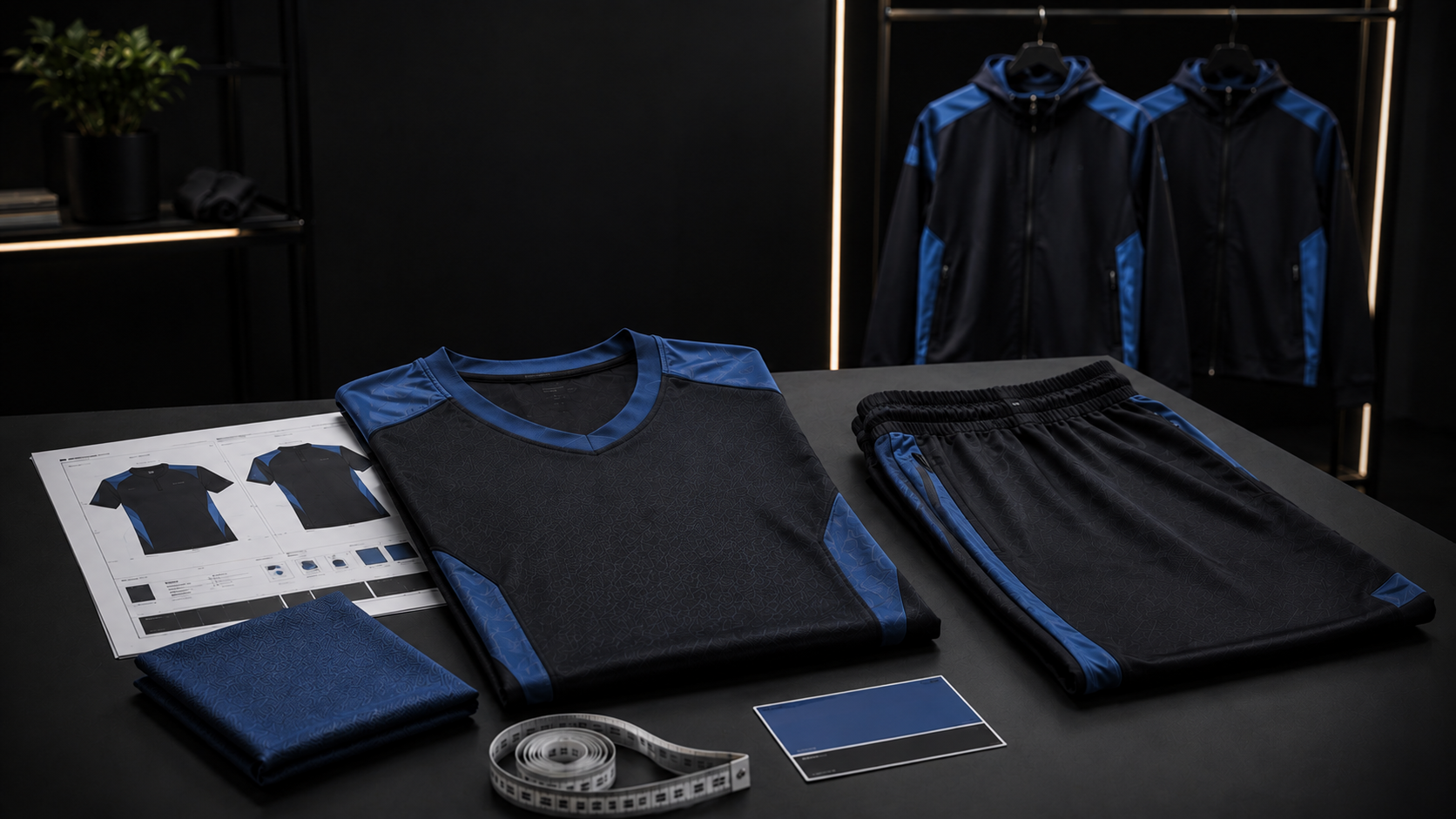
Teamwear manufacturing looks similar to retail apparel production from a distance — cutting, sewing, decoration, packing — but the operational reality is quite different. A retail brand can adjust its size curve after launch based on what sells. A club or league placing a teamwear order has to get every size right the first time, because every player on the roster needs a kit that fits, in a fixed window before the season starts, with no room to wait for a reorder.
This guide covers what actually makes teamwear production different, and what clubs, schools, and league organizers should understand before placing an order. It draws on the practical realities of producing kit for full rosters under fixed deadlines — the kind of constraints that don't come up in a typical retail apparel conversation, but that make or break whether a club's kit actually arrives, fits, and looks right by the time the first match of the season kicks off.
Retail apparel is produced against a forecast — a brand estimates how many of each size will sell and orders accordingly, with room to reorder a popular size later. Teamwear is produced against a known, fixed demand: a specific roster of players, each needing a specific size, with no flexibility to simply skip a size that's hard to produce or wait weeks for a top-up. This changes almost everything about how the order needs to be planned, from the sizing grid to the production schedule to how names and numbers are applied.
A teamwear order typically starts with a detailed sizing grid — every player's exact size, sometimes down to individual measurements for a closely fitted product like a compression base layer, rather than a general size curve. This means a single order might need one unit each of several sizes rather than the more efficient standard distribution (more mediums and larges, fewer extra-smalls and extra-larges) that a retail production run is optimized around.
Because of this, teamwear production often carries a higher per-unit cost than an equivalent retail order of the same total quantity, since the manufacturer isn't able to cut and sew in the efficient batches that a standard size curve allows. Clubs and organizers should factor this into budgeting rather than assuming teamwear pricing will match a general bulk apparel quote of similar volume. It also means the sizing grid itself becomes one of the most important documents in the entire order — more important, in some respects, than the design artwork — since an error here directly means a player receiving a kit that doesn't fit, with limited time to correct it before the season starts.
Some clubs manage this through a fitting session with sample garments in each size before the order is placed, letting each player try on a reference sample and confirm their size directly rather than relying on a size chart alone. This adds a small amount of lead time upfront but meaningfully reduces the number of fit-related reorders once the season is underway.
Where possible, collect actual body measurements rather than self-reported sizes (small, medium, large) from players. Self-reported sizing is one of the most common sources of reorders and mid-season fit complaints in teamwear.
Most modern team jerseys, particularly in sports like football, rugby league, and esports, use sublimation printing rather than screen printing, because sublimation allows for full-coverage club colours, gradients, and sponsor logos printed directly into the fabric rather than sitting as a separate layer on top. This also means the fabric itself is printed before the garment is cut and sewn — club colours, patterns and sponsor placements need to be finalized and approved before cutting begins, since changes after that point mean reprinting fabric from scratch.
Getting artwork finalized early — club crest, sponsor logos, exact colour codes matched to club branding — is one of the more common bottlenecks in teamwear production specifically because of this sequencing. A club that finalizes artwork weeks before the manufacturing deadline gives the factory far more room to catch and fix any colour-matching issues before bulk fabric is printed.
In teamwear, the deadline is fixed and non-negotiable — the season starts when it starts. Every other part of the timeline has to work backward from that date.Elevatex Editorial Team
Applying individual player names and numbers is a standard part of most teamwear orders, and it adds a layer of coordination beyond a standard bulk production run. A manufacturer needs an accurate, finalized roster — correct spelling of names, confirmed jersey numbers with no duplicates — well before bulk cutting, since name and number application typically happens as part of the same sublimation or print process as the rest of the kit design, not as a separate after-market step.
Clubs should also plan for the reality that rosters change — a new signing after the initial order, a squad number reassignment — and confirm with their manufacturer how individual reorders or additions are handled outside the main bulk production run, including realistic turnaround time for a single added kit.
Because a season start date rarely moves, teamwear orders need to be planned backward from that fixed point, with enough buffer for sampling, artwork approval, bulk production, and shipping — plus a reasonable contingency for any unexpected delay. A good rule of thumb is to begin the process at least eight to twelve weeks before kits are needed, particularly for a first order with a new manufacturer, since first orders typically involve more back-and-forth on fit and colour matching than a repeat order with an established relationship.
Clubs and organizers who leave teamwear ordering until close to the season start put themselves in a weak negotiating position on both price and priority, since manufacturers naturally prioritize orders with more production lead time when capacity is tight during peak season.
Different sports place different demands on teamwear fabric. High-contact sports like rugby need durable, abrasion-resistant fabric that can withstand grappling and turf contact. Running and endurance sports prioritize lightweight, highly breathable fabric with strong moisture-wicking performance. Indoor sports like volleyball or basketball often favour a slightly heavier, more opaque fabric given the closer viewing distance of spectators and broadcast cameras. Sharing the specific sport and playing conditions with your manufacturer — not just "team jersey" — helps them recommend a fabric weight and finish that will actually hold up through a full season.
A well-run teamwear program typically separates the initial bulk kit order — covering the full roster at season start — from a smaller reserve of blank, undecorated stock held for mid-season additions or replacements. This reserve stock can be personalized quickly with a new player's name and number without waiting on a full bulk production cycle, which is particularly useful for sports with rolling squad changes throughout a season. Ask your manufacturer whether they support this kind of reserve-stock arrangement, since not every factory is set up for quick, small-batch individual reorders outside a main bulk run.
Clubs budgeting for teamwear should plan for more than the per-jersey cost quoted upfront. A full kit order commonly includes home and away jerseys, shorts, training kit, and sometimes warm-up layers or travel wear, each with their own fabric, decoration and sizing considerations. Bundling these into a single order with one manufacturer is usually more cost-efficient and easier to manage than sourcing each piece separately, since setup costs for sublimation artwork and colour matching can often be shared across multiple garment types using the same club design.
It's also worth budgeting a modest contingency — both in cost and quantity — for mid-season replacements, whether due to squad changes, damage, or a player who was measured incorrectly the first time. Clubs that budget only for the exact roster size at the start of the season often find themselves negotiating a rushed, more expensive small-batch reorder mid-season, when a small buffer built into the original order would have covered it far more cheaply.
Finally, ask your manufacturer whether recurring seasonal orders — the same core kit design reordered annually with updated sponsor logos or minor colour refreshes — come with any pricing or priority benefit for returning clubs. Many manufacturers offer more favourable terms and faster turnaround once a working relationship and an established pattern file are already in place, which is worth factoring into a longer-term budgeting decision rather than evaluating every season as an entirely fresh sourcing exercise.
Teamwear is one of the more operationally demanding categories in sportswear manufacturing, precisely because there's no room for the flexibility a retail brand has. Working with a manufacturer experienced specifically in teamwear — not just general apparel — tends to make a meaningful difference in how smoothly a season's kit order actually comes together.
Elevatex International helps brands of every size — from first-time founders to established teamwear programs — go from a design brief to a finished, quality-checked product. Tell us what you're building.
Talk to Our TeamA general guideline is eight to twelve weeks before kits are needed, allowing time for sampling, artwork approval, bulk production and shipping, with extra buffer recommended for a first order with a new manufacturer.
Yes, many manufacturers can handle individual additions or replacements outside the main production run, though turnaround time is typically longer than the bulk order and should be confirmed directly with your manufacturer in advance.
Teamwear orders often require producing individual sizes per player rather than an efficient standard size curve, and frequently include individual name and number customization, both of which add production complexity compared to a standard bulk retail run.
It depends on the sport — high-contact sports need more durable, abrasion-resistant fabric, while endurance sports prioritize lightweight breathability. Sharing your specific sport and playing conditions with your manufacturer helps them recommend the right fabric weight and finish.
Actual body measurements are more reliable than self-reported sizes wherever practical, since self-reported sizing is one of the most common causes of fit complaints and mid-season reorders in teamwear.

Between a design file and a finished hoodie sits pattern making, cutting, sewing, decoration, and finishing. Here's what happens at each stage, and why it takes the time it does.
Read Article
A tech pack is the document that turns an idea into a garment a factory can actually cut and sew. Here's what belongs in one, and what happens when it's missing.
Read Article
One continuous walkthrough of the entire sportswear manufacturing process — from a locked tech pack to a container leaving the port — and where delays usually creep in.
Read Article